For this month’s issue, I had a couple of great topics lined up when a post by a notable figure in our industry sparked a debate about a couple of “bands” performing throughout the NY/NJ Tri-State area. MY DMs soon filled with people suggesting I address the issue in one of my upcoming Blast.
At first, I hesitated. I had my own opinion, but was it fair to use a newsletter for the people to take a side in a debate that was already heating up?
The final nudge came during dinner on the road with my wife and a few legendary artists. Some believed these bands could take gigs away from original artists, while others remained undecided. Ironically, my wife, whose market has been infiltrated by fake groups for over 25 years, had no problem with them.
Listening to both sides, I realized that the problem might start at the root, and questioned, were we all even talking about the same thing?
rather than simply sharing my opinion, I researched the history, examined the different categories these bands might fall into, and explored their potential place and impact within our genre.
The goal wasn’t to tell you what to think. I was to give you something more to think about. read the article, consider the facts, and then tell me what YOU think!
Also this month, I break down the Pull/Push metric and how it helps me understand the different needs of the artists on my roster. Unlike the traditional A,B,C ranking system, which I personally find way too subjective, this approach focuses on the level and type of attention an artist needs. Think of it like parenting. You can love all your children the same, while recognizing that each one needs different guidance and care. My artists aren’t my children, but I care about them all, and understanding their individual needs helps me support them better.
The Queen of The Blast Off, Lanah Skye, is back! She’s gathering her loyal followers for another seven day round, and two new challengers are ready to join her. Get in there, check out their music, and then decide who you’d like to support. It’s another opportunity to explore the talent within our community while training the challengers to push with all they got!
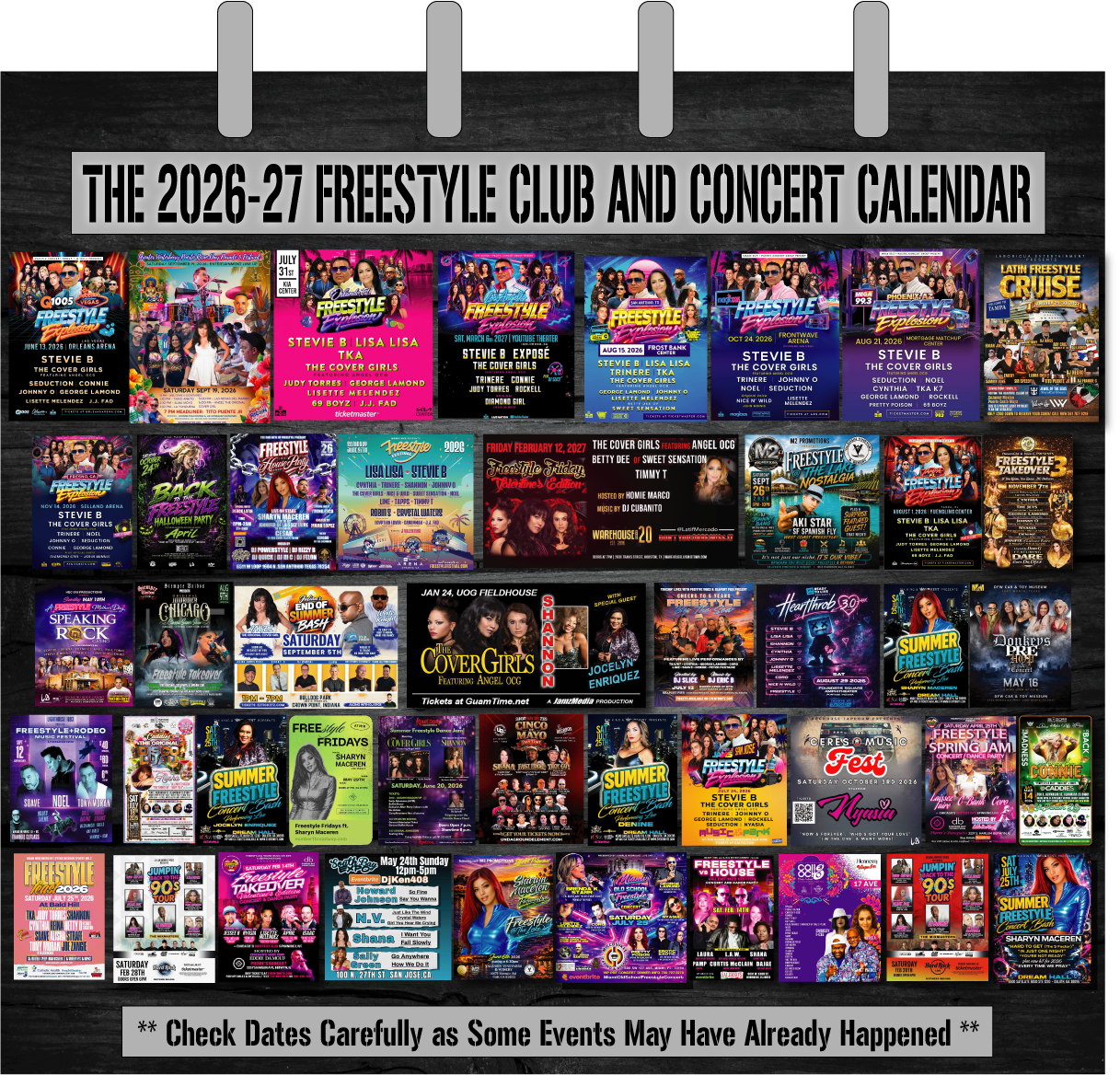
And don’t miss the Freestyle Club and Concert Calendar! Find upcoming Freestyle events in your area, see what you missed, and keep track of when they might return. For everyone still saying that “Freestyle Is dead,” I’ll let the Calendar speak for itself. From small nightclubs to major concert arenas, Freestyle is still alive and kicking.
So kick back, chill out, and dive into this month’s issue, where there’s a debate worth hearing out, a different perspective on artist management, new music drops, and a reminder of where to catch that next Freestyle event.
Now let’s get into it!
😏👉 Oh, and one more thing. The Freestyle Blast Newsletter will always be free. We don’t ask for donations, contributions, or tips. Instead, we ask for something even more valuable... your engagement.
Every Like, Heart, Comment, and Share helps us reach more Freestyle fans, grow this incredible community, and just as importantly, lets us know that the time and effort we pour into every issue truly matter.
Thank you for being part of this journey and for helping us keep the music as well as the memories alive.


COVERS, TRIBUTES & PHONIES: KNOW THE DIFFERENCE
This issue of The Freestyle Blast Newsletter was already heading in a whole other direction, until The Boss aka DJ Frankie Cutlass, posted something that got the Freestyle community a bit twisted.
At first, I wasn’t gonna chime in because anyone who’s followed me for any significant amount of time, remembers my days of fighting “Freestyle Phonies” inside my infamous Freestyle Against Phonies Facebook Group. I fought that fight for over 15 years, and to be quite honest, I’m tired.
But those days were different, and I still believe that FAP played an important role in our genre, and did shed some light on a subject that was both dark and confusing. One day I’ll dive back into that time, but for this article, I’d like to talk a bit about the following post.
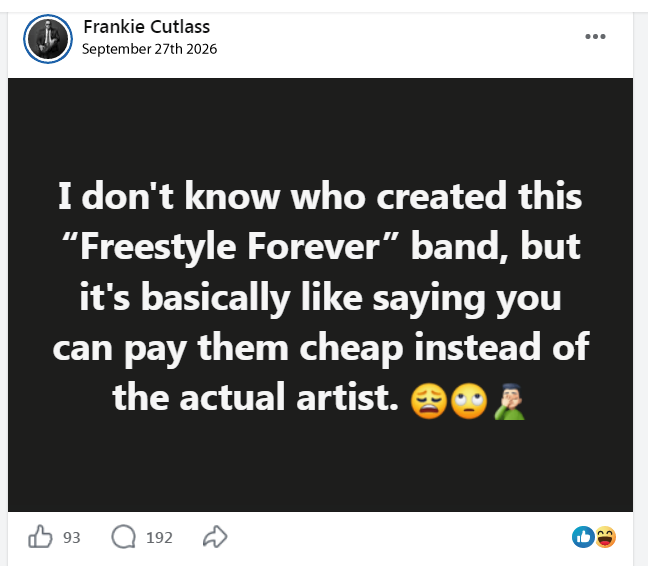
Let me first say this. I don’t like to exclude anyone’s opinion whether I might agree with it or not, because any opinion that I might have is also just that… an opinion!
The Freestyle community in every shape and form. Whether they be artists, DJs, producers, managers, agents, fans or anything in between. If you’re a supporter or contributor in any way to this genre, then I feel that your thoughts and opinions matter.
It can be a thought or ideology that to some of us might make absolutely no sense, either way, everyone still deserves to be heard, because we never really know. They might be on to something.
If you love this genre enough to listen to the music, go to the shows, buy the merch, or simply engage in any of these Facebook pages or groups, then you are indeed part of our community and anything you have to say about it counts.
Frankie Cutlass is without doubt a major player in this industry, and not just in Freestyle, in fact, Click this link for more info on The Boss.
His contributions to the genre definitely gains him a golden key to enter his thoughts, opinions and ideology into any conversation that opens, and just the thought that his success in the industry wasn’t based solely on his talent, but also the decisions he’s made for his career, and therefore, he shouldn’t just be heard, he should be listened to.
For those unaware of what he was actually addressing, has to do with an actual “Cover Band, or rather Bands” that have been touring the Freestyle circuit, mainly within New York / New Jersey tri-state area.
I’ve read some of the posts and have spoken to several people about the groups and I’m getting a lot of mixed thoughts on it, as well as some people who aren’t quite understanding the difference between Cover Bands, Tribute Bands, and Phonies, a term I myself sort of made famous among our Freestyle community.
Before we begin, I feel it’s incredibly important to first and foremost, understand the differences between the three categories in which I’ve seen the bands be placed under, because until we clearly understand this, we’ll never be able to pinpoint their actual function or intentions, and so, let’s go to Google for the rightful definitions.

#1 A Cover Band: A musical group that performs songs originally written, recorded, and made famous by other artists
#2 A Tribute Band: A musical group that performs the songs of only one specific legendary artist or band.
#3 A Phony Band: A musical group or act that fraudulently performs under the name of a famous original band or artist to deceive fans is also called an impostor band or fake band.
So let’s begin by first making it clear as to which definition the bands of this topic fall under, because at a first glance, that too can be misleading.
So based on the definitions, technically, the definition that that these types of bands should probably fall under would be definition #1, A Cover Band: A musical group that performs songs originally written, recorded, and made famous by other artists.
The reason this definition pops out is due to the last word, which in this case is ‘Artists” Which is exactly what these bands do, they perform various Freestyle songs by various Freestyle artists, because according to the definitions, to be considered a “Tribute” band, you must perform the songs of only “ONE” specific legendary artist or band.
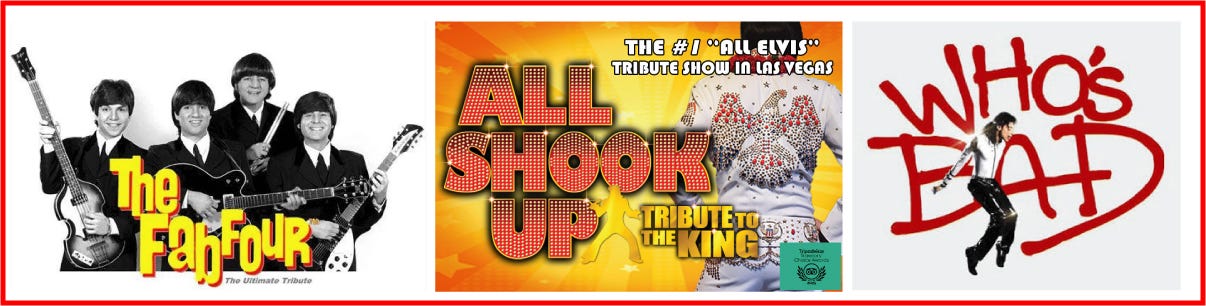
For example, if your band called themselves, “Funky Melody” a Tribute to Stevie B, made to look and dress like him and performed only his songs, then you would be considered a Tribute band. Other examples of tribute bands outside of Freestyle are acts such as The Fab Four a tribute to The Beatles. All Shook Up, a Tribute to Elvis Presley. And of course, the many many Michael Jackson Tribute bands such as, Who’s Bad.
These bands not only perform only the songs of that particular group or artist, they take on the entire persona of that act, through costumes, props or whatever other recognizable things brought in to better represent the act they are portraying.
Cover bands on the other hand, don’t take on the persona of any individual acts. These bands have their own look and style, yet perform a catalog of a variety of poplar hit songs. Songs that had at some time hit the Top 40 of their respected era or genre.
In one set, a Cover Band can open up with a song by KC and The Sunshine Band, to Earth, Wind, and Fire, then the Rolling Stones, into a Michael Jackson, Journey, Kenny Rogers, then close with Stairway to Heaven by Led Zeppelin.
Cover Bands have been popular since the 50s and 60s, and many Cover Bands went on to gain their own successful place in the music industry such as The Beatles, The Rolling Stones, Black Sabbath, and Panic! at the Disco, just to name a few.
But the term “Cover” also has a bit of a darker side of history as the idea was once used to infiltrate those segregated radio stations and markets, where black artists were not allowed. This is a little bit off topic, but still sort of related, and really interesting, so let me share what I learned.
You see, back in the day, white record companies, in order to further capitalize from those song catalogs they owned, would have white artists and bands record or should I say, “Cover” those hit songs originally released by black artists.
Another term used was “Sanitizing the music” Where white artists such as Pat Boone covered songs by artists such as Little Richard and Fats Domino. Not only were these songs recorded, they were also watered down on their energy and slang for a more conservative audience.
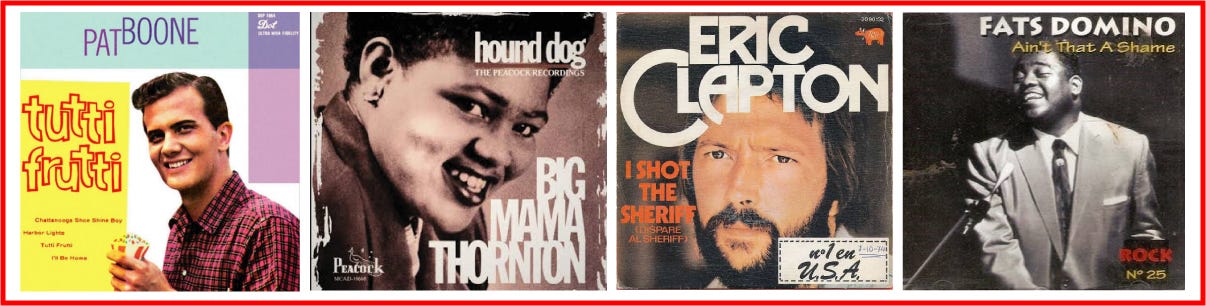
Racial segregation cut off access to the mainstream market for black artists, mainly through white-owned radio stations and their refusal to support black artists, regardless of the popularity they would’ve gained from the black audience.
We can’t place all the blame on the radio stations either, because their main objective is to sell advertising, and when those advertisers warned to pull their ads if they played any of “that” music, radio stations really had no choice.
The record companies knew that they were leaving a ton of money on the table and therefore commissioned popular white artists to record and release these songs, many of them gaining massive commercial success along with huge paydays, never crediting or compensating any of the original artists.
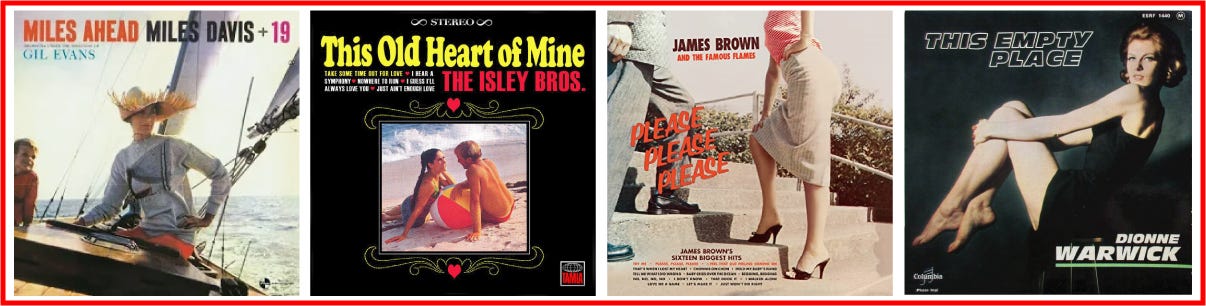
As the 1950’s and 1960’s rolled around, the youth of those days began to desire more of the authentic releases by black artists, and knowing that many record retailers would not stock any product with black artists on it, they began disguising those records by using generic artwork, scenery, drawings, cartoons, and of course, white models.
This infuriated a lot of the artists, and confused many of the fans. In one story I read, upon seeing his Miles Ahead album cover for the first time, Miles Davis asked a Columbia Records executive, “Why’d you put that white bitch on there?”
So now that we’re a bit clearer of the categories… Where exactly do these Freestyle Bands fall under?
Can we consider them “Cover Bands?” Well, they do perform various songs from various artists, though not necessarily all Top 40. These bands are performing Only Freestyle songs by Freestyle artists with quite a few of them never reaching Top anything, let alone Top 40.
What about a “Tribute Band?” Can these Freestyle Bands be considered that? Well, according to the definition of a Tribute band, it’s noted as a musical act or group that performs the songs of only “ONE” specific legendary artist or band, and that’s something they don’t do either.
So then all that would be left would be a “Phony or Fake Band,” can we call them that? and of course we Can NOT! Because they’re not portraying themselves as the original artists, nor are they deceiving fans into thinking that they are to sell tickets.
And so I hit a wall! After dissecting the three common categories, I realized that those Freestyle bands didn’t totally fit under any of them. So I dove back in, and in doing so, I remember once on a cruise ship watching a performance called The Motown Revue. Here was a band that performed all the different Motown songs by the different Motown artists. This concept was super close, except for the part that says “Revue” because, a “Revue” referred more so to a Theatrical Performance” aka a sort of “Musical” play, which made sense as the Motown Revue that I had experienced was on a cruise ship, and they didn’t just play they era, they became it.
I kept digging and found another band that did the same with artists and songs from the 1980’s. These were bands that didn’t just perform Top 40 songs, nor did they perform the songs of just one artist or group. These bands dedicated their performances to an entire era or genre of music.
And so back to the drawing board I went, until finally I found what I was looking for. There was a fourth category that I had never heard of before and it was called, a Genre- Specific Cover Band or Niche Band, and it did exactly as the name implied.
And to confirm that we are categorizing these bands correctly, let’s jump back into Google and ask in reverse..
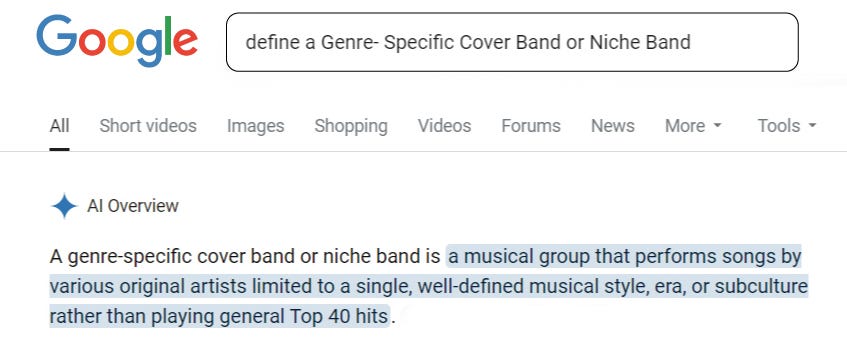
And so, there it is!
These bands don’t play just Top 40 hits, such as your traditional Cover Band, nor do they perform the songs of just one artist or band. Instead, the Genre- Specific Cover Band performs the music of just one specific genre. Whether that be Motown R&B, Soft Rock, Heavy Metal, Doo Wop, or in this case, Freestyle, a genre of a very specific 80’s dance music.
And though these bands will not try and impersonate any particular band or artist, by adopting their persona, they will in fact, dress to represent that particular era.
And so
The bottom line is this folks. Freestyle cover bands are going nowhere. There’s no way to protest them, shun them, or blackball them from our genre. In fact, as the years move on and we begin to lose more and more of our artists, those bands are not only going to gain even more popularity, they’re going to become a necessity toward the sustenance and legacy of the Freestyle music genre. It’s artists, and culture.
Will these bands in anyway affect our bottom-line? Will they take gigs away from our artists? And will they ever become the new face of Freestyle? Click the comment button below and let’s continue the discussion and see what the rest the Freestyle community has to say about it.
Once again, thank you Frankie Cutlass for bringing up this interesting, and very important topic,
The Pull / Push Theory. What is that?
There are two types of artists that I represent. Those who I consider Pull Artists, and Those I consider Push Artists...
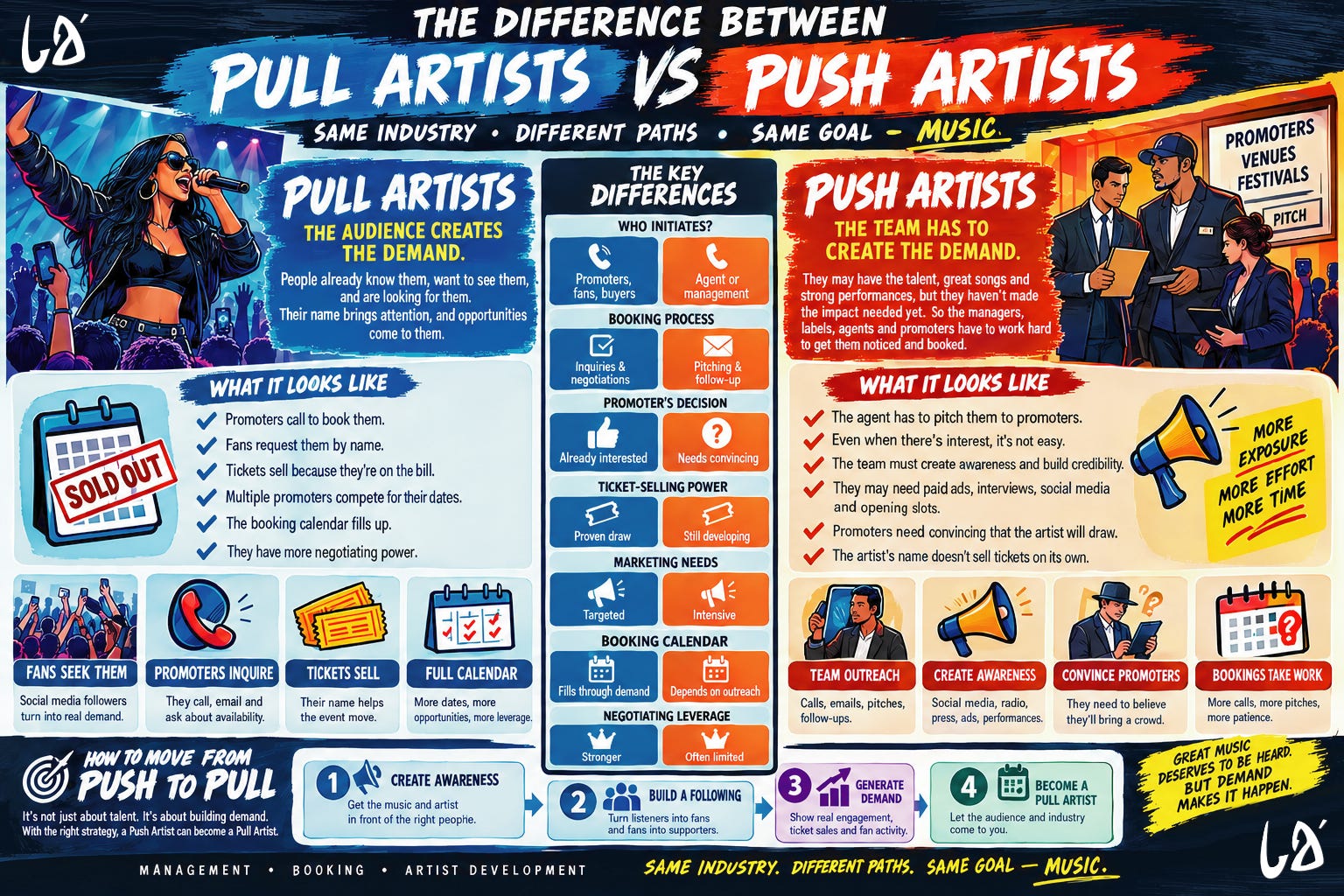
These are not “titles” that I gave them, but it does define how the market treats them.
It’s an extremely delicate subject and not one that I speak of much, nor do I even speak to the artists themselves about it, because some can very easily take it the wrong way.
Fans might not even understand it, and neither would promoters. But as a Booking Agent, to me it’s clear as day, and forces me to handle each artist very differently. Let me explain.
In past issues I’ve mentioned the distinction between A, B, and even C List artists. A-Listers are generally those headlining acts that are most in demand and who can command higher performance fees. B-Listers also work regularly and can headline smaller events, usually at more affordable fees. C-Listers are often booked to fill the gaps, adding value to a lineup, but don’t normally go out on their own.
Of course, there are exceptions, and some of these classifications can be subjective.
The problem with what I call the “Alphabet Metric” is that it can play with the ego, both positively and negatively.
A-Listers love the title, sometimes to the point where they develop a sort of boujee mindset and place themselves on a pedestal. Then there are the B-Listers who take offense because they feel they belong in the A-List category. And C-Listers? Many are simply grateful to have a letter associated with them.
But here’s the thing. Knowing an artist’s A,B, or C status doesn’t necessarily tell me what I need to know as a Booking Agent.
An artist might be considered A-List and still need to be pushed because promoters aren’t convinced that their asking price is justified. Another artist might be considered B or C-List but generate steady bookings because their price makes sense for what they bring to the table.
That’s why I don’t rely on the Alphabet Metric when it comes to booking my roster. I use what I call the Pull / Push Metric.
And with this metric there are only two categories.
PULL ARTISTS
Pull artists are those acts where, if I sit in my office, the calls will eventually come in. Promoters are already looking for them, fans want to see them, and opportunities come their way.
The hard work has already been done through hit records, consistent performances, name recognition, and nowadays, an online presence built by the artist and their team.
A Pull Artist doesn’t necessarily command the highest fee, but the fee they charge is generally justified by the demand, and it’s rarely negotiated.
PUSH ARTISTS
Then there are the Push Artists. These are the acts that need to be pushed into the line of view.
Their careers rely heavily on the work being done behind the scenes. I’m talking about pitching promoters, making calls, sending emails, following up, creating awareness, and convincing people to give them an opportunity.
And here’s the reality. When the pushing stops, the interest can stop right along with it.
All artists begin as Push Artists. Some make the transition to Pull Artists fairly quickly, and that can happen for a variety of reasons. others need more time, more exposure, and a stronger strategy to build demand.
And remember, a Pull Artist isn’t determined by their fee. Some artists on the higher end of the price scale still have to be pushed because promoters don’t think the price is justified.
One the other hand, a lower priced artist can become a Pull simply because their fee makes sense for the value they bring. I know artists who are priced exceptionally low, and it’s working in their favor because they’re working consistently.
The trade-off is that one artist might work a lot of shows for a moderate or low fee, while another might perform less often but earn a much higher fee per show. neither strategy is wrong, as long as the artist and their team understand and are comfortable with the terms.
This Pull / Push theory applies to all kinds of businesses and industries. the goal is to turn your Push products and services into Pulls.
Think about McDonalds compared to a local Mom and Pop restaurant.or a perfume you might buy at Macy’s compared to one you’d pick up at Walmart.
same idea applies to our artists. It’s not about looking down on anyone. It’s about recognizing how the market works and using that knowledge to plan your strategy.
Everyone starts somewhere. In the beginning, nobody knows you, your music, or your story. Your first job is to get them to know you. And with social media, there are more ways than ever to make that happen.
So what are you doing to work your way to becoming a Pull artist? And once you get there, what are you doing to stay there?
As an agent with a pretty significant roster, I find myself booking certain artists more than others. And while it might seem that I’m giving more attention to the artists who are working more often, the reality is usually the opposite.
Some of the artist who aren’t working as much as I’d like are getting the bulk of my attention. these are the artists I’m constantly pitching, or should I say, pushing!
It’s not something that I particularly like talking about to artists, because no artist really wants to hear that they’re a Push Artist. But in my opinion, it doesn’t discredit them or take away from their talent. It’s simply a realization of where they stand in the market today.
And as long as they’re onboard and willing to put in the work, so am I.
So, to the artists and team members reading this, take a moment to figure out where you stand. Are you a Pull Artist, or are you still a Push Artist?
Understanding the difference can help you develop a better strategy, set realistic expectations, and understand why some bookings come easier than others.
And as always, if you have any questions, you know how to reach me.
So… what are your thoughts in regards to the Pull / Push metric? let us know in the comments below. We’d love to hear’em.




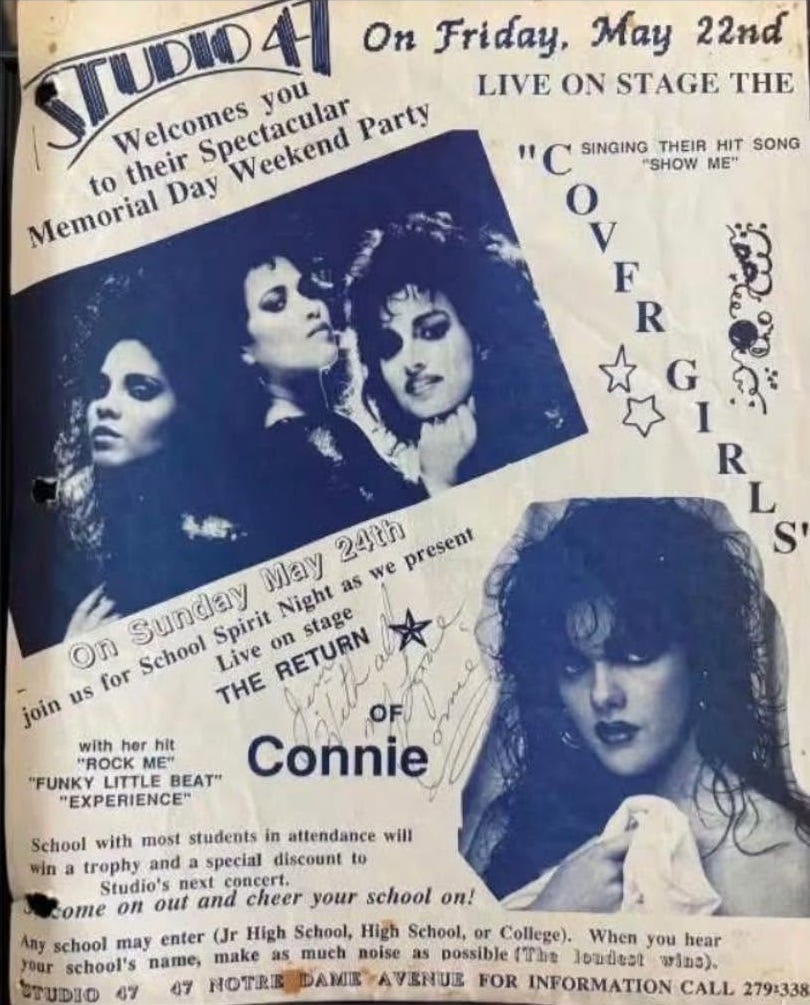

💥 Check Out This Video 👇😲




To all our Subscribers, Readers, Subjects, and of course our Sponsors, for being a part of this month’s issue of the Freestyle Blast Newsletter, Thank you all so much!
and until next time…
This was your Freestyle Blast!


Latif Mercado has been a part of the Freestyle Music scene for well over 30 years, as well as an integral player behind the genre’s continued success.
As a Booking Agent with a who's who roster of Freestyle Greats, as well as his managerial involvement with such industry icons as Lil' Suzy, Angel OCG, and The Cover Girls, rarely would you find a Freestyle event happening without Latif somewhere in the mix.
Latif loves hearing from his readers, answering questions, and sharing whatever advice he possibly can, so be sure to reach out, even if it’s just to say hi.
and please Follow Him Everywhere Latif Mercado